 Fabulator
Writing faction conflicts that give Players a side to pick

Most faction conflicts fail in the same way. One side is plainly the villain, the other is plainly decent, and the Player's choice is a formality. Nobody ever feels the decision.
A conflict a Player can actually pick a side in has a different shape. Both factions are right about something, both are costly to join, and neither can be dismissed in a single sentence. This article walks through a method for building that shape, then shows where each piece goes when you author a World Seed on Fabulator.
Start with what each side is right about
Write one sentence per faction that completes the phrase "They are right that...". Not "they believe", but "they are right". If you cannot finish the sentence for a faction, it is not ready to carry a conflict.
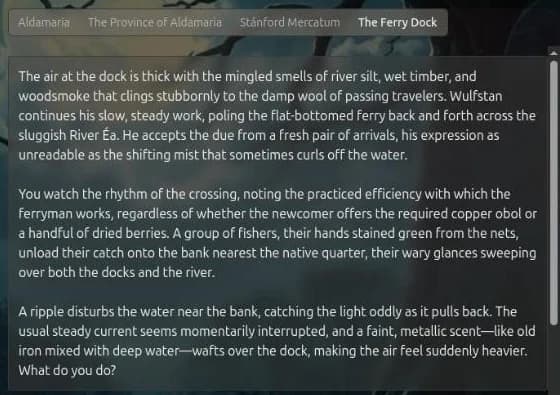
Imagine a river city split between a Toll Guild and a Dockhands' League. The Guild is right that the city's bridges, dredging and flood walls cost real money and collapse without steady funding. The League is right that the people doing the lifting are paying for all of it and seeing none of it. Neither claim cancels the other. That is the point.
Give each side a method, not just a motive
Motives make factions sound alike. Methods make them distinct. The Guild raises a toll, inspects cargo and quietly bribes. The League organises slowdowns, shares information through the taverns and shields its own. When a Player encounters either one, the method tells them who they are dealing with before anyone speaks.
A useful check: what would each faction do on an ordinary day with no crisis? If the answer is the same, the methods are not different enough.
Attach a cost to every alliance
A side is only a choice if joining it closes something. Decide what each faction demands in return for its help, and make that demand something a thoughtful Player might hesitate over. The Guild offers safe passage and legal standing, and asks for a name on its ledger. The League offers loyalty and hidden routes, and asks for a favour that will eventually put someone in danger.
Notice that neither cost is a penalty applied by the system. These are consequences the world itself supplies, which is where they carry the most weight.
Let each faction believe things the other denies
Conflicts get sharper when the factions disagree about the past as well as the future. The Guild may hold that the old flood was an act of weather. The League may hold that it was a decision made in a counting house. Both versions can sit in your world without either one being true by default.
Fabulator draws a deliberate line here. Canon records what is actually true in the fiction, while belief records what a faction holds to be true, and the two are stored separately. That lets you keep a mystery with a real answer while the factions argue about it. The narrator can voice each side's version when that side is speaking, without letting a character's belief quietly overwrite what happened.
Where this goes when you author it
Each of these pieces maps onto fields on a Faction card, one of the structured World Card types an Author fills in rather than writing lore as loose prose:
- Ideology holds core beliefs, goals and taboos. Your "they are right that" sentence and the things they will never do belong here, and taboos act as local constraints on how the narrator portrays them.
- Structure holds leadership, membership requirements and how the group is organised. This is where a method becomes concrete: who decides, who is allowed in, who answers to whom.
- Assets holds resources, territories and known secrets. A cost to join is often a secret or a resource the faction guards.
How the factions stand toward each other, whether allied, hostile or wary, is stored as a relationship between cards in the knowledge graph rather than as a column on either card. Locations can be tied to the factions that hold influence there, so a bridge district can feel like Guild territory without you restating it in every scene.
The reason to enter all of this as structure is that the game can use it. World rules and faction taboos are converted into constraints when the narrator's prompt is assembled, so a faction that never takes bribes is less likely to be written taking one. Prose that contradicts the card can be flagged and regenerated.
A short checklist before you publish
Before you call a conflict finished, test it with a few questions:
- Can you write "They are right that..." for both sides without strawmanning either?
- Does each faction have a method you could recognise from behaviour alone?
- Does joining either side cost something a Player would think about?
- Is there at least one thing each side believes that the other denies?
If you can answer yes to all four, a Player who arrives in your city has a real decision waiting for them, and the narrator has what it needs to make that decision feel weighty.
Build one
If you have a conflict in mind, try it as two Faction cards and a handful of locations. The authoring tools let you work on cards directly, and the Creator SDK is there if you later want programmatic rulesets or behaviours on top. Start small: two factions, one disputed place, one thing each side will not forgive.
Build a world other people can play
Author a World Seed — locations, characters and lore — and publish it for others to play. No code required.