 Fabulator
No rulebook required: what playing an AI-narrated RPG asks of you

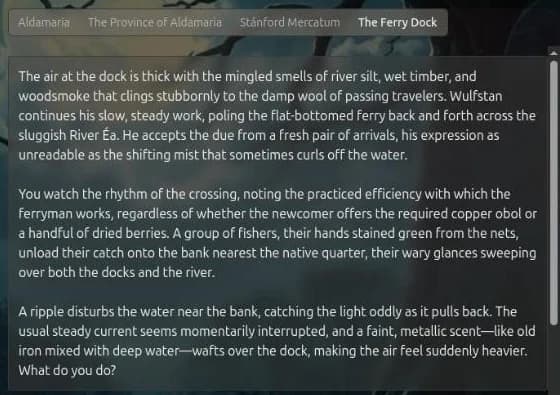
Picture someone who has never opened a rulebook. A friend mentioned a fantasy campaign, so they start one, read the opening paragraph, and then stare at the input box. The scene has a guard at a gate. They type: "I tell the guard my cousin works in the kitchens and I'm late with a delivery."
That sentence is the whole interface. There is no character sheet to decode first, no table to look up, no term of art to get right. The question worth asking is the skeptical one: if I know none of the rules, does the game quietly punish me for it?
What you actually type
Fabulator accepts free-form text. You describe what your character says or does in ordinary language, and a parsing step translates that into a structured intent the game can work with. The design note in the generation-flow concept doc calls this a translator rather than a restrictor: it structures creative input like "threaten the merchant with a club" instead of limiting you to a fixed list of verbs.
So you never need to know that persuading a guard is called a Charisma check, or that there is such a thing. You say what you want your character to do. Where the campaign uses a ruleset, there may also be contextual action buttons you can use as shortcuts, but they are an option, not a requirement.
Who knows the rules, then
The software does. When a campaign has rules enforcement on, the game maps your action to a check, for example a persuasion attempt against a difficulty number, and the rules engine resolves it in code. The dice are rolled by the host, the modifiers from your character's stats and skills are added, and the result is compared against the target.
You do not do that arithmetic. You are shown the outcome, and the roll breakdown is recorded in an audit log so the exact numbers (the die, the modifier, the total) are available if you are curious. The narrator then writes the scene around the result. If the roll failed, the guard does not wave you through, and the prose reflects it.
The important part for a newcomer is the order of operations. The rules engine decides what mechanically happened, and the narrator describes it. The narrator is not free to simply decide you succeeded because the sentence was charming, and it is not free to invent a failure that the dice never produced.
What if you do not want mechanics at all
Rules enforcement is a per-world, per-campaign setting. A world can run with no ruleset, which the specification calls Narrative-First mode: the rules engine is skipped and the story proceeds as a conversation with a narrator. Campaigns also carry settings for inventory enforcement and rules enforcement that you can find in the campaign settings.
If dice and difficulty numbers sound like homework, this is a reasonable way in. If you later become curious about how a check was resolved, you can turn the structure on and watch what changes. Neither mode is the "real" one.
What you do need
Rules knowledge is not the missing ingredient. These are the things that make a session go well:
- A direction. One sentence about what your character wants is enough to start. "I want to find out who stole the ledger" gives the narrator something to build on.
- Specific verbs. "I search the study for letters" gives the engine something to resolve. "I look around" gives it less.
- Willingness to be surprised. Outcomes come from the story's records and the rules, not from your intentions alone.
You also do not have to hold the world in your head. Campaign canon, the current state of your character and the world, and the memory of what has happened are kept as separate records, so the narrator is working from a store of facts rather than from whatever you last remembered to repeat.
A short, honest caveat
Experienced tabletop players will find more to chew on. A ruleset such as the one that ships with Aldamaria has attributes, skills and difficulty numbers, and a player who enjoys optimising a build can find depth there. That is a choice about how deep to go, and it sits on top of a game you can enjoy without any of it.
If you have wanted to try a roleplaying game but the barrier was the rulebook, the barrier is lower here than it looks. Open Discover, pick a World Seed whose description sounds like a place you would like to stand in, and type one sentence. You can learn the system by playing, or never learn it at all.
Play an AI-narrated story of your own
Fabulator is an AI game master that tracks your characters, places and choices. Pick a published World Seed and play, or author your own.