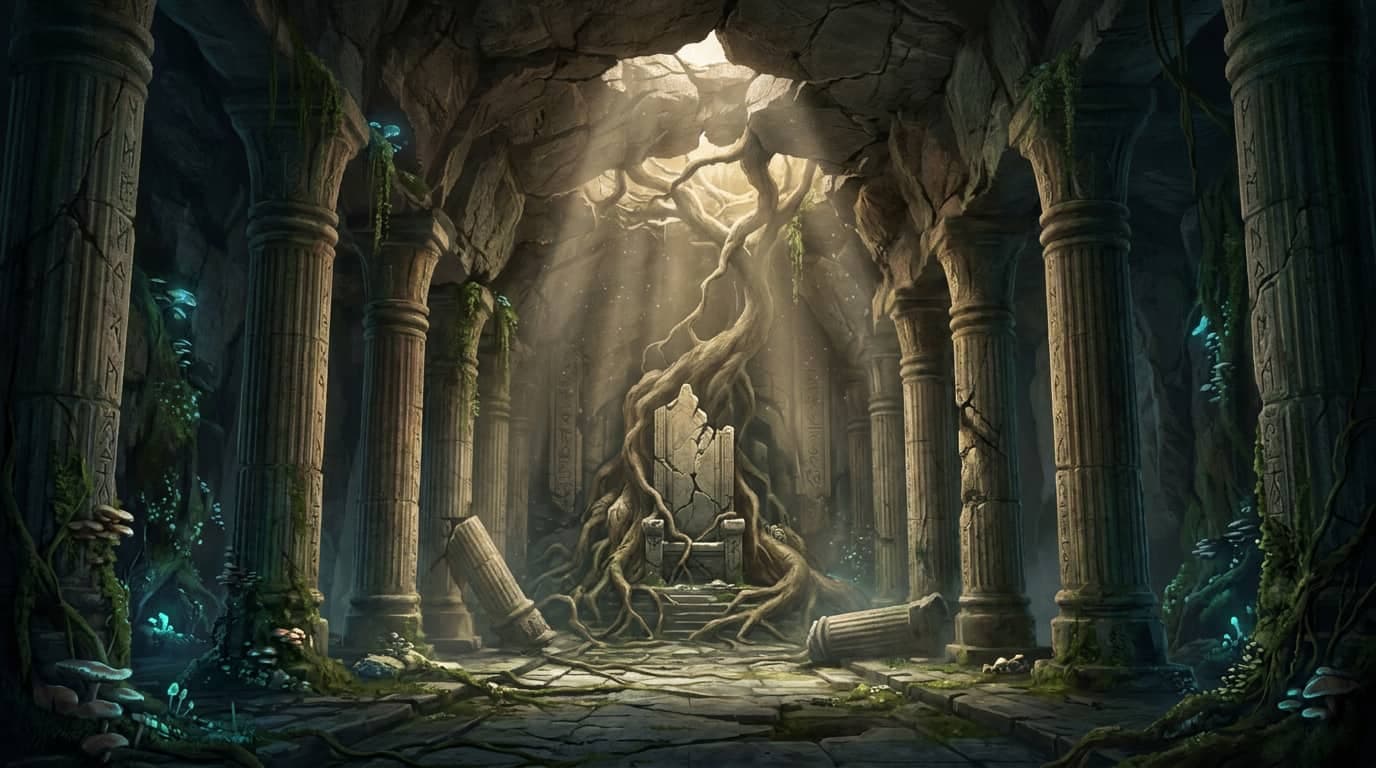

Building tension into a location description
Tension is a gap, not a monster
Most first-draft location descriptions are inventories. A tavern has a bar, some tables, a fireplace and a smell of ale. Everything on the list is accurate and none of it makes anyone lean forward.
Tension comes from a gap between what a place should be and what it is. A tavern should be loud. If this one is quiet, with every patron facing the door, the player feels it before anyone explains why. You do not have to put danger in the room. You have to put a question in it.
Here is a technique you can use on any location: the three-layer pass.
Layer one: the expected baseline
Start by writing down what the player assumes about this kind of place. A tavern is warm, noisy and welcoming. A shrine is calm. A market is crowded. This is the baseline, and it is useful precisely because you are about to break it.
Do not skip this step. Tension is relative, so you cannot dent something you have not defined.
Layer two: one wrong detail, with a sensory anchor
Pick a single detail that violates the baseline, and anchor it in a sense other than sight. Imagine a tavern called The Drowned Saint (a name used as an illustrative example in Fabulator's own design docs). The baseline says: warm, loud, welcoming. Now break it:
"The fire is lit, but nobody sits near it. The floorboards are damp underfoot, though it has not rained in days, and every conversation stops half a sentence early when you walk past."
Notice what the passage does. It names three small wrongnesses, each one concrete. It does not say the tavern is "ominous" or "tense." It gives the player evidence and lets them draw the conclusion. Words like "eerie" do the reader's work for them and usually land flat.
A few habits help here:
- Prefer one precise odd detail over five vague ones.
- Use sound, smell, temperature and texture, not just appearance.
- Let people react. A room full of characters behaving oddly is more unsettling than an empty room.
Layer three: an unanswered question with a way to pull on it
Tension collapses if the player cannot do anything about it. The last layer is a thread they can pull. Why is the floor damp? Who are they all avoiding looking at? Give the location at least one answer that exists in the world, even if it is hidden. Maybe the damp traces back to a cellar door, and a faction has an interest in keeping it shut.
If you cannot say what the answer is, the player will eventually sense that there isn't one. A good rule of thumb is that you, as the Author, should know the answer even if no player ever finds it.
Putting it on a Location Card
On Fabulator, canon lives in typed World Cards rather than loose prose, and a Location Card has fields that line up with this technique:
- Environmental conditions hold the sensory profile: weather, light, hazards. This is where the damp floor and the unlit corners go.
- Lore facets hold history, culture and architecture. This is where the answer to your question lives, such as what happened in the cellar.
- Associated factions record who holds influence there, which tells the narrator who might be keeping the secret.
Because the narrator draws on this card when the scene is active, the wrongness is not something you have to rely on a player to notice in a single paragraph. The details can resurface across turns as the story returns to the room.
Making the rules of the place binding
Authors can also write World-Rule Invariant cards: explicit constraints the narration must respect. If your shrine is supposed to be silent, an invariant can say so, and the system's consistency checks are designed to flag prose that contradicts it. This stops the tension from deflating when a narrator drifts into cheerful chatter in a place that was meant to be hushed.
For something more dynamic, Plot Point cards let you define trigger conditions, such as "the player enters the cellar," along with a prose directive that tells the narrator how that moment should be rendered. That is how a quiet unease can escalate when the player reaches the right place instead of all at once.
A quick checklist
Before you finalize a location, ask:
- What does the player expect here?
- What is the one concrete detail that breaks it?
- Which sense carries it?
- What question does it raise, and where is the answer?
- Which fields on the card hold each of those?
If you can answer all five, the location is ready.
Build one yourself
You do not need a whole world to practice. Pick one place from a setting you care about and run the three layers on it. When you are ready to turn it into something others can play, Fabulator's authoring tools are the place to start building your World Seed.