 Fabulator
Designing an opening location that always leaves a next step
The first scene of a campaign has one job: make the next move obvious. Not forced, just visible. A Player who arrives somewhere vivid but inert will often type something small and tentative, because nothing in the scene has offered them a handle. Many openings fail this way, and they fail even when the writing is good.
Here is a technique that fixes it, along with how Fabulator's tools let an Author apply it.
Give the location three handles
Think of the starting location as a room with three kinds of handles on it. You do not need many of each, but you want all three kinds present.
- A way out. Somewhere to go: a road, a door, a stair, a ferry. It should lead to another place that exists in your world, not to vague "elsewhere".
- Someone to talk to. A person, an animal, a voice behind a hatch. They want something small, or know something small.
- Something that is wrong. A detail that invites investigation: a locked cellar, a fresh grave, a ledger with a torn page.
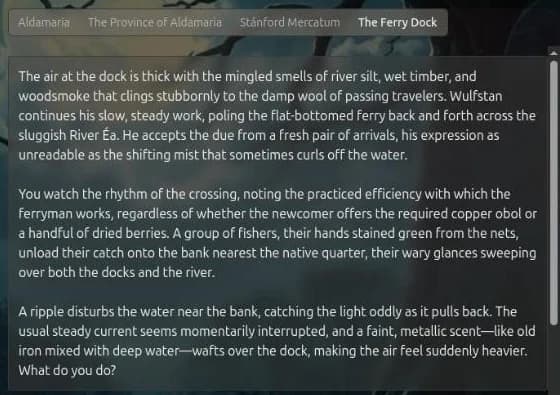
An example. Suppose you are opening a campaign in a river-crossing inn. The inn has a ferry landing at the back (a way out). The ferryman refuses to cross after dark and will not say why (someone to talk to, with a small secret). The innkeeper's cellar door has a new padlock on it (something wrong). A Player who types nothing more clever than "I look around" is already holding three threads, and every one of them leads somewhere.
Keep the handles specific
"A mysterious stranger sits in the corner" is a handle shaped like a blank. Compare "a woman in a salt-stained coat is counting coins onto the table and keeps glancing at the ferry". The second gives the narrator, and the Player, something to build on, and it does so in a single sentence.
A useful check: could a Player act on this detail using only words from the description? If they would have to invent a noun first, sharpen it.
How this maps onto Fabulator
World content in Fabulator is stored as structured cards rather than one long block of text. Locations are one kind of card, arranged in a hierarchy from broad places down to rooms, and the narrator is shown where the Player currently is along with the larger places that contain it. Because that location is tracked state rather than something inferred from the last few paragraphs, an opening scene that is well described stays well described for as long as the Player remains in it.
On the authoring side, a few things matter for this technique.
- Mark the location as a starting location. Any Location card in a World Seed can be flagged as a candidate start. If you flag exactly one, every campaign cloned from your World Seed begins there. If you flag several, each new campaign begins at one of them, chosen at random and then fixed for the life of that campaign. If you flag none, the campaign starts without a grounded location, which works but gives the narrator less to anchor on.
- Use several starts for replayability. Two or three starting locations, each built with its own three handles, make a World Seed feel different on a second run without extra writing elsewhere.
- Place characters where they will be found. A character card can be given a starting location, so the person you intended the Player to meet is in the scene from the first turn rather than wandering in later.
- Connect the places. The handles only help if the way out is a place your world actually contains. Locations that sit in the same hierarchy, parent, child and neighbour, are the ones the engine can recognise when narration says the Player has moved.
A quick review before you publish
Read your opening location aloud and answer three questions. Where can a Player go? Who can they speak to? What would they want to find out? If any answer is "nowhere", "nobody" or "nothing", add one concrete handle and test again. Then pick the one detail you are proudest of and ask whether it is something a Player can act on or only something they can admire. Keep the admiring detail, but make sure an actionable one sits next to it.
Start building
If you want to try this, open the authoring tools and create a World Seed with a single location, mark it as a starting location and write the three handles. Or, if you work in code, the Creator SDK is the route for rulesets and behaviours. Either way, you will learn more from watching a Player take their first turn in your opening than from another round of polishing the description.
Crea un mundo que otros puedan jugar
Crea una Semilla de Mundo — lugares, personajes y lore — y publícala para que otros la jueguen. Sin programar.